Mary’s Newtown Blasted Over Facebook Post

The popular burger joint in Sydney controversially posted an Easter Facebook ad earlier this year that read: ‘Jesus got hammered for his sins, you can too’ (refer to image 1).

Image 1: Mary’s Newtown controversial Facebook post adapted from bandt.com.au.

On the 17th of April 2019; Mary’s Newtown posted an announcement on their Facebook page to inform their followers of their opening hours over the Easter long weekend. This post backfired when multiple consumers and followers deemed the post ‘disrespectful’, ‘disgusting’, and urging them to remove the post (Burnie, 2019). This escalated even further by a Facebook group lead by Orthodox Christian’s who encouraged followers to post negative comments about the business in retaliation to the post (Foster, 2019). The co-owner of Mary’s reportedly stated that the post wasn’t meant to offend anyone (Forster, 2019). As a small local business a case like this, caused by a combination of mismanagement and misunderstanding; can have impactful consequences where reputation is damaged.

The rising emergence of social media raises ethical concerns about the potential to facilitate deception, social grooming and this case, the creation of defamatory content (Sweney and Gosden, 2006). There was an absence of self-reflection that Mary’s did not perceive any offence within the post.

The contribution of this facet has impacted Mary’s fail, as consumers are able to voice their opinions where morality does not always come into play. The vernacular affordances of social media are sharing, liking, disliking and reporting content. This can make hiding publicly displayed content difficult. Facebook is a platform that helps you connect and share with the people in your life (Graham, 2019), it promotes behaviours of ‘compulsory publicness’. It grants a consumer choice of what to post and share- it is wholly up to the discretion of the user.

Social media ethics can be seen as a human concern, in which people have control over the way technology is utilised. Light and McGrath (2010) state that users are thus, “able to design systems and employ preventative measures to guard against the likelihood of undesirable behaviours and outcomes.” Consequentialism should be noted of a user’s actions, as it is their duty and moral characteristics that need to be taken into consideration of others’ emotions and rights.

An important ethical component of using social media as a marketing tool for a business is to ensure that peoples beliefs are not trodden on/ upset/ offended; or their beliefs are not taken advantage of. Some companies have used a shock approach marketing effect to advertise their products, which would have been considered as an advantage gained by the additional attention (a positive impact), in comparison to the customer loss. In the case of Mary’s, there was no shock attention intended, in this case, not all publicity is positive. The consumer reaction was very negative in regard to the intended message of the post. This can be due to technology developers holding a user-oriented view; they regulate particular aspects of interaction through privacy and acceptable-use policies, and the rest is left up to the user’s choice and their views of morality (Light; Mcgrath, 2010).

Interpersonal ethics is another element that links into morality and virtuous ethics. Mary’s Easter post breached social standards, however there is a mutual responsibility which is shared between the user and Facebook as a platform. There is no simple binary between the platform and user, as each shape one another; however, users are responsible for their sharing of certain content. In the case of Mary’s, the post wasn’t overtly offensive, in that it didn’t set out to attack religion or beliefs. Mary’s needed to take responsibility for the post and enact procedures to ensure it doesn’t arise again. Social media platforms need to develop and promote healthy online policies (Gillespie, 2017), in order for businesses such as Mary’s, to not get as viciously damaged from one un-intentional post.

To avoid the fail, as a sole responsibility the user must correctly regulate their online content (Brock, 2016). A crucial factor is to implement checking procedures between multiple entities who share different perspectives. Establishing a small test group between employees and some consumers outside of the business will help in determining consumer reaction. This is because one person’s perspective does not cover a large enough segment of the customer base to determine the level of appropriateness of a post.

As a director of the business, key prohibited areas should be established and not be publicly discussed on social forums. Each post should be coedited and approved by the owner of the business. Mary’s did not have a correct understanding of their target market and therefore were unable to connect and use the influence of spreadable media to their advantage.

References

The Rise of the ‘Social Influencer’

By Holly Howard

N9481061

Social media has made a vast impact on life within the past decade. Social platforms have signalled a move away from what was once a stagnant web, to a more open and participatory online domain (Kelly, 2005). It has become the core of many people’s social lives and is a powerful symbol that has come to represent entrepreneurialism, innovation, freedom, participation and revolution (Marwick, 2013). This shift in the market has led consumers to form an online ‘presence’ where they can meet other likeminded people, form collectives, create and easily share content (Fuch, 2014). According to Jenkins (2009), spreadable media is one of the main characteristics of social media; stating “if it doesn’t spread, its dead”. An involved audience creates a participatory online culture. Consequently, the development of the ‘influencer’ was born. Influencers are ordinary internet users who have accumulated a large following on social media platforms through the textual and visual narration of their personal lifestyles (Rettberg, 2015). They monetise their following by integrating advertising and promotional samples into their posts, that constructs self- branding mechanisms.

Self-representations have always been a social act. Since 2008 self-representation in social media has become more visually sustained, open to the largest audience than ever before (Rettberg, 2017). Social media as a whole encourages users to compete for social benefits through visibility and attention. In boosting their social status, users adopt self- consciously constructed personas to market themselves like a brand (Marwick, 2013). Online personas are detailed and highly edited versions of oneself by conforming to social ideals (Marwick, 2013). These factors are embedded into an influencers lifestyle, where social media promotes such behaviours to endorse a number of likes or shares. The difference between ordinary users and influencers, is that most people do not monetize their use of social media.

Influencers can be termed as users who have networked coinciding and have been transformed by networked media, its properties, and its potential (Boyd, 2010). This in turn introduces new possible practices. Before the development of Web 2.0, jobs such as influencers would not exist today. Social media influencing reaps the benefits of opening up a new career sector, that requires little to no qualifications. Technology articulates a world of wealth in which regular people, without Ivy League educations or family connections, can use the tools of the web and application development to become very rich (Hitt, 2018). Iona Maclean for example, is a self-proclaimed ‘digital content creator’ (see image 1), amongst multiple other creative enterprises she certifies herself in. She does not have a job or tertiary education, per say, but rather earns her credits through her social media account and personal blog. Influencers have become accustomed to use advertising, sponsorship and advertorials to make money in social media, relying on their online following to create ‘personal’ connections so their followers remain loyal (Rettberg, 2017).

Influencer marketing is the fastest-growing online customer- acquisition method as Google searches for influencer marketing grew by 1500% over the last 3 years (Marketing Hub, 2019). In recent years, influencer marketing has become largely centred around social media, creating an opportunity for brands to market through individuals on social media. These users are representing companies through their personal social media accounts including Instagram, YouTube, Snapchat and Twitter (Glucksman, n.d). Jenkins (2009), argued that spreadable media can empower consumers to involve them in creating success for a brand. A longer-term benefit for a brand is the strengthening of consumer loyalty ‘by increasing emotional attachment to the brand or media franchise’ (Jenkins et al. 2009, part 8).

Copenhagen influencer Josefine Haaning Jensen has over 734,000 followers on Instagram and has become somewhat of an icon within the fashion industry. She has formed paid partnerships with multiple international brands, where she is photographed wearing or using the product (see images 2 and 3). Brands selectively choose key influencers to represent the brand rather than the target market as a whole (Hitt, 2018). This is because more than ever before, consumers purchase behaviour is based on word of mouth or reviews/ sponsorship of ‘like-minded’ individuals.

Affordance is a key term for understanding and analysing social media interfaces and the relations between technology and its users (Bucher, Helmond, 2016). Gibson (2015) states that ‘the richest and most elaborate affordances of the environment are provided by other animals and, for us, other people.’ Meaning that behaviour enables behaviour- some acts will influence other acts. These social affordances are the technological structures in which the internet influences user’s everyday life (Bucher, Helmond, 2016).

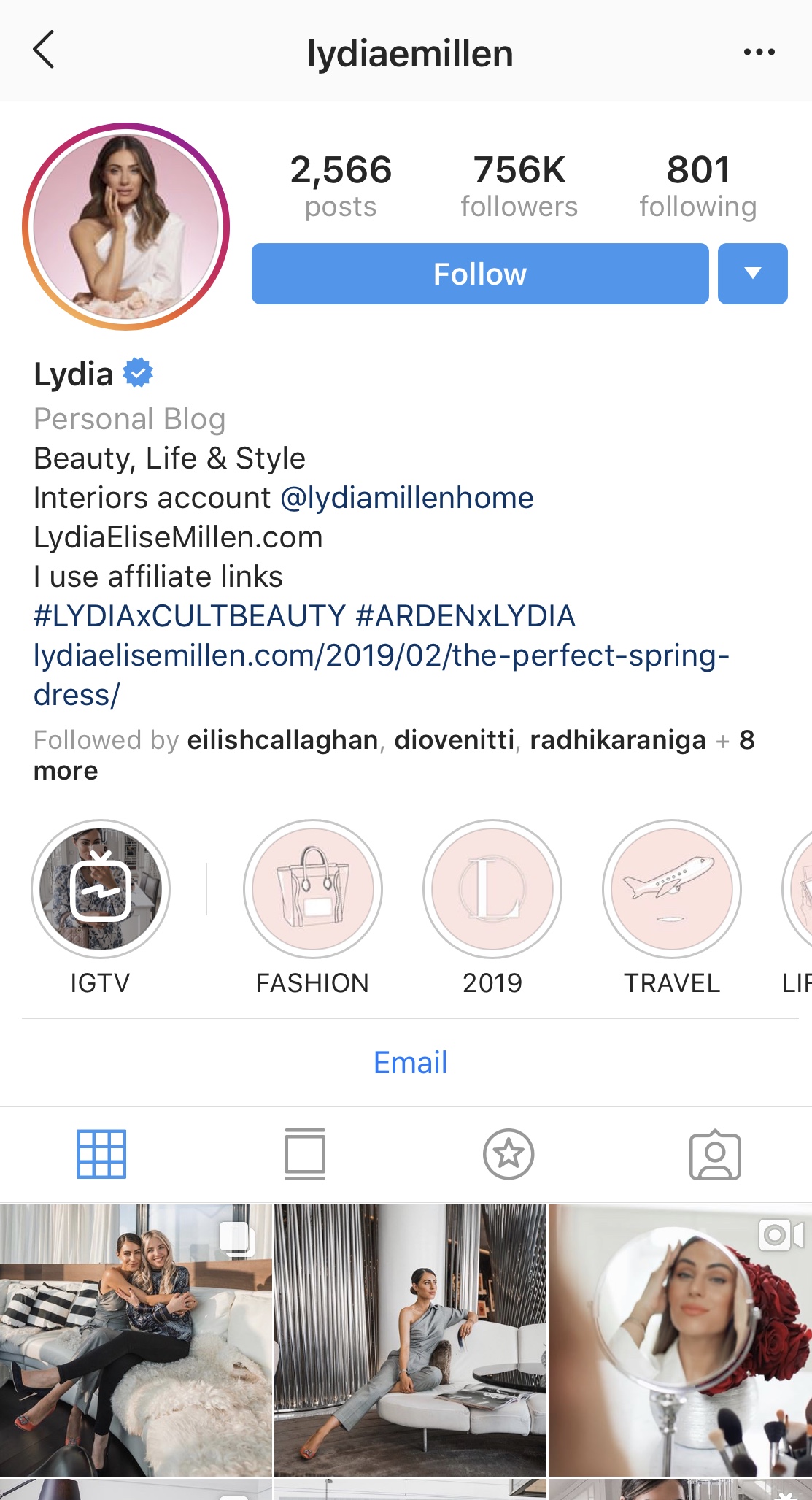
Social media can be understood as a tool that increases the media power of individuals and institutions (Stevenson, 2018). Rossetto believed that the social and participatory culture of the internet, were only important as a means for brands to better connect with the audiences to sell targeted advertising (Stevenson, 2018). Influencers tend to use multiple platforms in order to create a stronger advertising appeal. It is common to see an Instagram profile that shares links to a personal blog, website, Snapchat or YouTube account. Refer to Lydia Millen where her Instagram profile (see image 4) shares links to a second Instagram account specifically for interior design, an email address, a website and hashtags relating to her posts.

Influencers use these social platforms for individual expression whilst establishing and maintaining bonds to their ‘online community’. This behaviour was first seen in the earlier blogging communities, where the genre’s authenticity was juxtaposed to that of the impersonal voice of mass media and dot.com (Stevenson, 2018). Influencer’s online personas need to frequently engage with their audience by inviting acts of expression and connection for the mere sake of doing so- regardless of how mundane or ordinary their tasks may be (Quinn & Papacharissi, 2017). Therefore, true identity of influencers turns into a performative act. This theatricality of performance is what social media entails. Influencers are regarded to always ‘perform’ both online and offline in order to sustain a particular impression on followers they have obtained; without sacrificing one’s true sense of self (Quinn & Papacharissi, 2017).

In order to successfully market a brand, influencers must carefully portray their ‘true self’ and ‘performative self’ to maximise their content and attain a loyal following. Without this following, the networked individual could lose out on a marketing opportunity, and therefore their income. As connections consist of a mix between family, friends and acquaintances within one singular social space, the networked individual must traverse these audiences with full consistency in self presentation (Marwick, 2013). This creates unreasonable and very high expectations to continually uphold.

References:

Boyd, D. (2010). “Social Network Sites as Networked Publics: Affordances, Dynamics, and Implications.” In Networked Self: Identity, Community, and Culture on Social Network Sites (ed. Zizi Papacharissi), pp. 39-58.

Bucher, T., & Helmond, A., (2017). “The Affordances of Social Media Platforms.” In J. Burgess, A Marwick and T Poell, eds. The SAGE Handbook of Social Media. Sage, London.

Fuchs, C., (2014). Social Media as Participatory Culture. Retrieved from http://sk.sagepub.com/books/social-media-a-critical-introduction.

Glucksman, M. (N.D). The Rise of Social Media Influencer Marketing on Lifestyle Branding: A Case Study of Lucie Fink.

Hitt, T., (2018). The Inscrutable Rise of the Online Influencer. Retrieved from: https://www.thedailybeast.com/the-inscrutable-rise-of-the-online-influencer

Influencer Marketing Hub. (2019). The State of Influencer Marketing 2019: Benchmark Report. Retrieved from: https://influencermarketinghub.com/influencer-marketing-2019-benchmark-report/

Kevin, K. (2005). We are the web. Wired August 1. http://www.wired.com/wired/ archive/13.08/tech.html

Marwick, A. (2013). Online Identity. In J. Hartly; J. Burgess & A. Bruns (Eds.), A Companion to New Media Dynamics (pp. 355-364). West Sussex, UK: John Wiley & Sons Ltd.

Quinn, K., Papacharissi, Z. (2017). Our Networked Selves: Personal Connection and Relational Maintenance in Social Media Use. In Burgess, J., Marwick, A. E., & Poell, T. (Eds.). (2017). The sage handbook of social media. Retrieved from https://ebookcentral.proquest.com.

Stevenson, M. (2018). From hypertext to hype and back again: exploring the roots of social media in the early web. In J. Burgess, A Marwick and T Poell, eds. The SAGE Handbook of Social Media. Sage, London: p 69-87.

Terry, F. (2014). Introduction to New Media. In Terry, F. (4th Eds.), New Media (pp. 1-17). South Melbourne: Oxford University Press.

Image 1
Image 2
Image 3
Image 4